
REACT – Renewable Electrochemical Advanced Conversion of CO₂ to Target products
Global ethylene production exceeds 317 million tonnes annually, yet more than 95% is currently produced through fossil-based steam cracking processes that generate approximately 260 million tonnes of CO₂ emissions each year. REACT aims to transform this carbon-intensive sector by providing a renewable alternative that converts industrial emissions into valuable resources.
The project focuses on recycling CO₂ from hard-to-abate industries such as steel, cement, and chemical manufacturing. Through a novel impurity-tolerant tandem electrochemical process, REACT can directly convert low-purity industrial CO₂ streams into valuable chemical products while significantly reducing the need for costly pre-treatment.
REACT advances circular carbon value chains, strengthens European industrial autonomy, and contributes to the transition towards climate-neutral chemical production. The project also integrates innovative materials, advanced monitoring systems, and digital twin technologies to enhance efficiency, durability, scalability, and economic feasibility.
Why REACT Matters
Industrial CO₂ emissions are often considered an unavoidable by-product of essential manufacturing processes. REACT challenges this perception by turning emissions into a valuable feedstock for next-generation chemicals and materials.
By combining renewable energy with cutting-edge electrochemical conversion technologies, REACT offers a pathway to:
- Support the production of sustainable polymers, chemicals, and fuels
- Reduce dependence on fossil-based feedstocks
- Lower the carbon footprint of chemical production
- Valorise industrial CO₂ streams from hard-to-abate sectors
- Enable circular and resilient European value chains
About the Project
REACT is a Horizon Europe project developing an innovative tandem electrochemical process to directly convert industrial CO₂ emissions into valuable olefin-rich chemical mixtures for the sustainable production of polymers, chemicals, and fuels.
REACT (Renewable Electrochemical Advanced Conversion of CO2 to Target products) is funded by the European Commission (Grant Agreement No. 101269395) under the call for strengthening the industrial carbon management value chain (HORIZON-CL5-2025-02-D3-27). Running for 48 months from May 2026 to April 2030, the project has a budget of approximately €8.4 million and features an elite consortium covering the entire value chain, from world-renowned scientific institutions to raw material suppliers and manufacturers of polymers for the packaging sector.
Dr. Bernd Wittgens, Project Coordinator at SINTEF, states: “I’m grateful for the opportunity to kick off this important project together. Turning CO₂ into valuable chemicals is an inspiring challenge, and I truly appreciate everyone’s dedication and collaboration as we take these first steps toward a more sustainable future”.
Project Partners
The consortium is coordinated by SINTEF (Norway) and includes 13 partners from 10 countries: VITO (Belgium), Johnson Matthey PLC (UK), eChemicles (Hungary), Procter & Gamble Services Company NV (Belgium), IDENER (Spain), Norner Research AS (Norway), Empa (Switzerland), K1-MET GmbH (Austria), FARPLAS (Turkey), Johnson Matthey Davy Technologies Ltd (UK), Holoss (Portugal), and ETA-Florence Renewable Energies (Italy).
SINTEF (Norway): SINTEF is one of Europe’s largest independent research institutions with over 2,200 employees from 80 different nationalities. SINTEF creates value through knowledge generation, research and innovation, and develops technological solutions that are brought into practical use. In REACT, SINTEF is the project coordinator and leads WPs 2 and 6. In WP2, SINTEF is responsible for data collection, sharing, and storage to set the ground for future activities within REACT. SINTEF will carry out process design and scale-up together with techno-economic analysis (TEA) as part of WP6.
VITO (Belgium): as a leading European research organization in cleantech with over 1,400 employees from 65 different nationalities, VITO drives the core technology development of REACT by leading WP3 and WP4. VITO will design and host two integrated pilots at its location in Mol: one converting CO2 to CO, and a second pilot transforming that CO into ethylene, showcasing a scalable pathway for sustainable chemical production.
P&G (Belgium): P&G serves consumers around the world with one of the strongest portfolios of trusted, quality, leadership brands, including, but not limited to: Always®, Ambi Pur®, Ariel®, Bold®, Braun®, Dawn®, Fairy®, Febreze®, Gillette®, Head & Shoulders®, Herbal Essences®, Lenor®, Olay®, Oral-B®, Pampers®, Pantene®, SevenSeas®, Tide®, Tampax®, Venus® and Vicks®. Headquartered in the US, P&G brands are used in millions of living rooms, kitchens, laundry rooms, and bathrooms and have been passed down from generation to generation. P&G is committed to making peoples’ lives better in small but meaningful ways, every day.
K1-MET GmbH (Austria): K1-MET is a leading and internationally renowned Austrian metallurgical competence centre. In the REACT project K1-MET’s role is to provide impure industrial CO2 feed streams and their input will contribute to establishing techno-economic trade-offs between upstream purification costs and operational efficiency of the conversion technology, ensuring the project’s solutions are grounded in industrial reality.
Empa, the Swiss Federal Laboratories for Materials Science and Technology (Switzerland): Empa is the leading material science institute in Switzerland working on global challenges. Within REACT, Empa is investigating degradation processes in the electrochemical carbon dioxide conversion to carbon monoxide and ethylene, which are currently the major bottleneck to the implementation of this important technology.
eChemicles (Hungary): eChemicles is a world leader in low temperature electrolysis converting CO2 to carbon monoxide using renewable energy. The carbon monoxide can then be used to create valuable products such as chemicals and sustainable fuels or used in manufacturing processes like steel or semiconductors. The technology is designed to drive the profitable transition of industries toward reduced environmental impact.
Norner Research AS (Norway): Norner Research is a Norwegian independent research institute specializing in polymers, materials technology, and industrial sustainable solutions. Within REACT, Norner is responsible for downstream processing activities, including purification of ethylene streams and conversion into polymers: HDPE and PP/PE copolymers. Norner contributes its expertise in purification, polymerization, material characterization, and product validation to ensure that CO₂-derived ethylene can be transformed into high-quality materials. Overall, Norner plays a key role in translating the project’s chemical conversion results into market-ready products and demonstrating end-use performance.
Johnson Matthey (UK): Johnson Matthey (JM) is a world leader in platinum group metals (PGMs). For over 200 years, the company has used advanced metals chemistry to tackle the world’s biggest challenges. Many of the world’s leading energy, chemicals and automotive companies depend on JM technology and expertise to decarbonise, reduce harmful emissions and improve their sustainability. And now, as the world faces the challenges of climate change, energy supply and resource scarcity, JM is actively providing solutions for their customers. In REACT project, Johnson Matthey develops and optimises catalysts and electrodes for impurity-tolerant CO₂-to-ethylene conversion, supporting scaling up the CO2 to Ethylene tandem electrolyser technology in WP3, and enables downstream conversion of ethylene into value-added products in WP6, linking thus innovation to real industrial use.
FARPLAS (Turkey): Farplas is a full system automotive company with +50 years of experience. Farplas designs, develops and manufactures vehicle plastic parts, electronic based ceiling and lighting systems and instruments panels. In the field of manufacturing, Farplas has core competencies in material development, product and process engineering, painting and coating, mould design, prototyping, and test and analysis.
HOLOSS (Portugal): HOLOSS develops cross-sector solutions to adopt sustainable, health-conscious technologies and services while balancing environmental and human health priorities. In REACT, HOLOSS leads Work Package 7: Sustainability, Circularity, and Life-Cycle Assessment, managing the Life Cycle Assessment, End-of-Life strategies, and applying the SSbD framework, ensuring long-term sustainability.
HOLOSS R&D (Portugal): HOLOSS RESEARCH translates scientific research and innovation into sustainable solutions that generate measurable public value. In REACT, HOLOSS RESEARCH will contribute to WP7 by applying its expertise in assessment and simulation software to support the implementation and comprehensive understanding of sustainability.
IDENER (Spain): IDENER is a private research company in Computational Mathematics and systems optimization. Within REACT, IDENER will monitor and control the containerized plant, develop RES integration strategies, and create the digital twin. IDENER will also oversee energy use, process efficiency, conduct socio-economic impact assessments, and define the exploitation strategy, including the business case.
ETA-Florence Renewable Energies (Italy): ETA is a leading consultancy firm in communication and dissemination strategies for energy innovation. Within REACT, ETA coordinates Work Package 8, managing the visual identity, website, social media, and stakeholder networking to maximize the impact of project results.
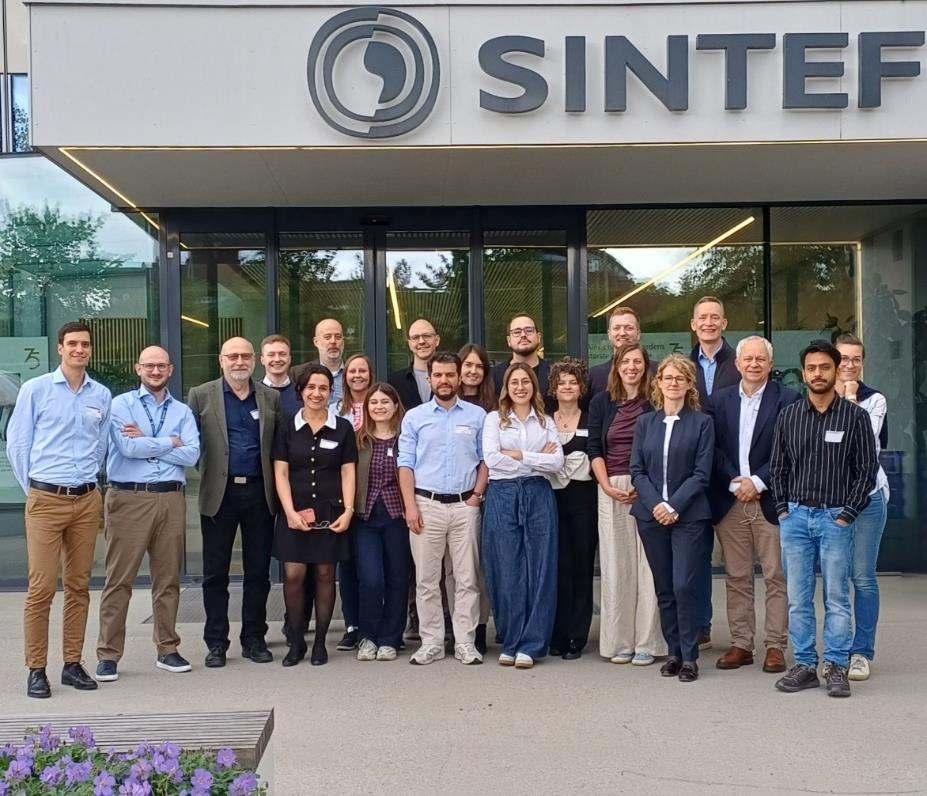
The project partners met on 2–3 June 2026 at the SINTEF offices in Oslo to refine the planned activities for the coming months, initiating discussions across all work packages.