About us
The Project
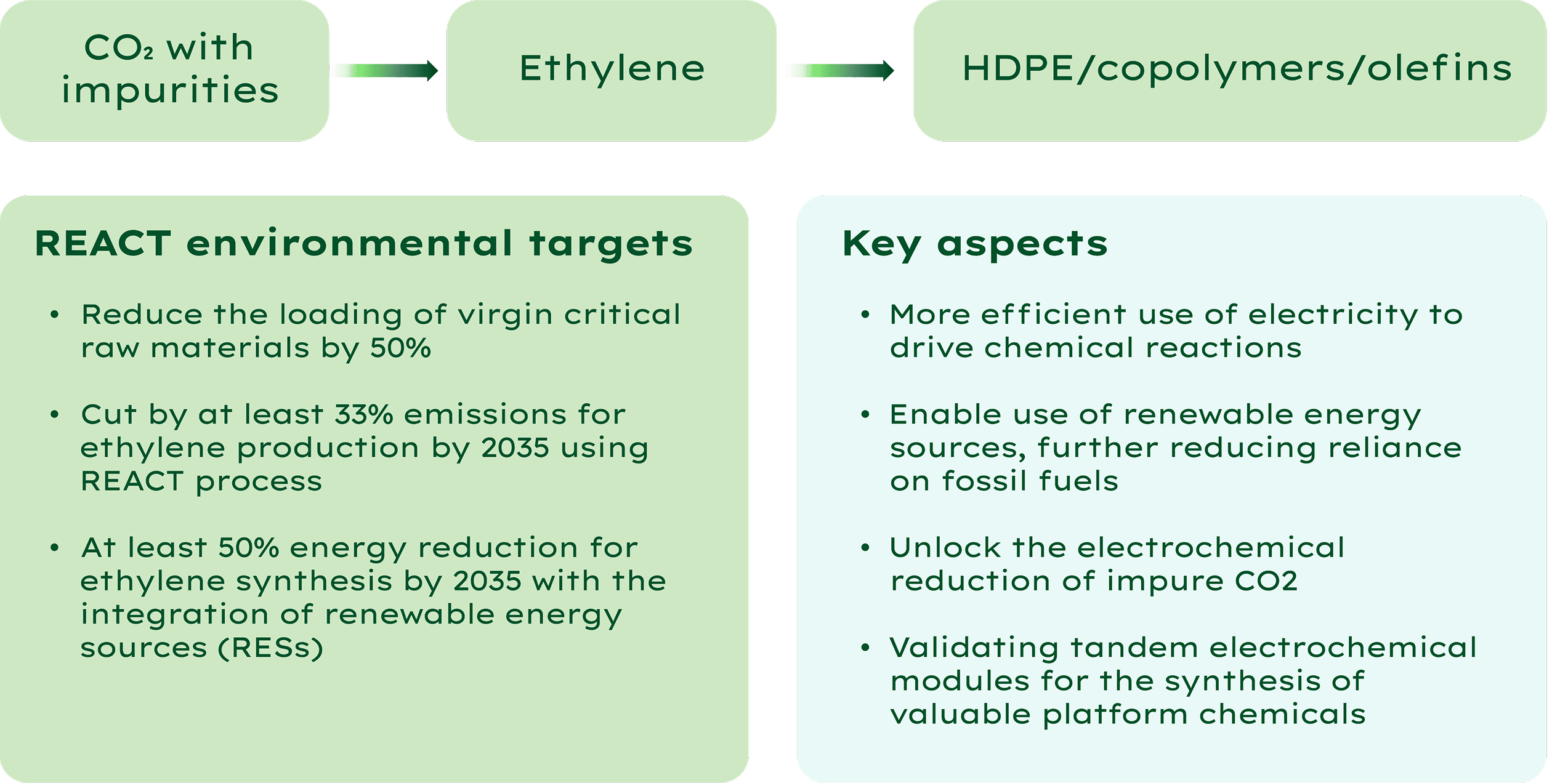
REACT is a Horizon Europe project developing an innovative tandem electrochemical process to directly convert industrial CO₂ emissions into valuable olefin-rich chemical mixtures for the sustainable production of polymers, chemicals, and fuels.
REACT (Renewable Electrochemical Advanced Conversion of CO2 to Target products) is funded by the European Commission (Grant Agreement No. 101269395) under the call for strengthening the industrial carbon management value chain (HORIZON-CL5-2025-02-D3-27). Running for 48 months from May 2026 to April 2030, the project has a budget of approximately €8.4 million and features an elite consortium covering the entire value chain, from world-renowned scientific institutions to raw material suppliers and manufacturers of polymers for the packaging sector.
Dr. Bernd Wittgens, Project Coordinator at SINTEF, states: “I’m grateful for the opportunity to kick off this important project together. Turning CO₂ into valuable chemicals is an inspiring challenge, and I truly appreciate everyone’s dedication and collaboration as we take these first steps toward a more sustainable future”.
Benefits of the project

Renewable electrochemical conversion of industrial CO₂ for sustainable chemicals production

Reduced dependence on fossil feedstocks for synthesis of polymers, chemicals, and fuels

Testing of innovative materials for electrolyzer components

Building resilient and circular industrial value chains

Strengthened European industrial autonomy

Digital twin optimisation for advanced monitoring and scalable deployment
Methodology
Within the REACT project, two electrochemical devices will be developed and validated up to relevant scale (TRL-6) to convert CO2 and H2O into syngas, and then CO into ethylene, both at low temperatures.
The REACT team will initially focus on developing impurity-tolerant components for the electrochemical cell. In the second stage, the electrochemical devices will be scaled up to produce a significant amount of ethylene.
The REACT project will also investigate the most effective route to purify ethylene for the synthesis of polyethylene (PP) and α-olefins for relevant industrial applications, such as production of plastic materials, including copolymers, and speciality olefins.
Application
- Packaging
- Polymers and copolymer production for automotive
- Precursors of surfactants and other speciality chemicals
Expected results

Industrially feasible electrochemical reduction of impure CO2
For the conversion of CO2 to ethylene, a platform molecule for the synthesis of plastic materials and speciality chemicals

Improving electrochemical processes and materials
A knowledge base on the impact of industrial impurities on the conversion system

Energy efficiency gains and less energy-intensive products
- Demonstrate the tandem electrochemical processes at pilot scale
- Scale-up the technology at a demo-scale
- Harmonised technology assessment for fair qualification of the full process

Integrating electrochemical processes with renewable energy sources (RESs)
Incorporating modelling and simulation tools to make RES exploitation real

AI-based solutions and digital twins to stabilise electrochemical processes
- Tools for optimised process control and monitoring of the REACT process
- Algorithms and strategies to minimise the negative impact of impure feed gas supply and RES power fluctuation on efficiency, yield and electrode performance